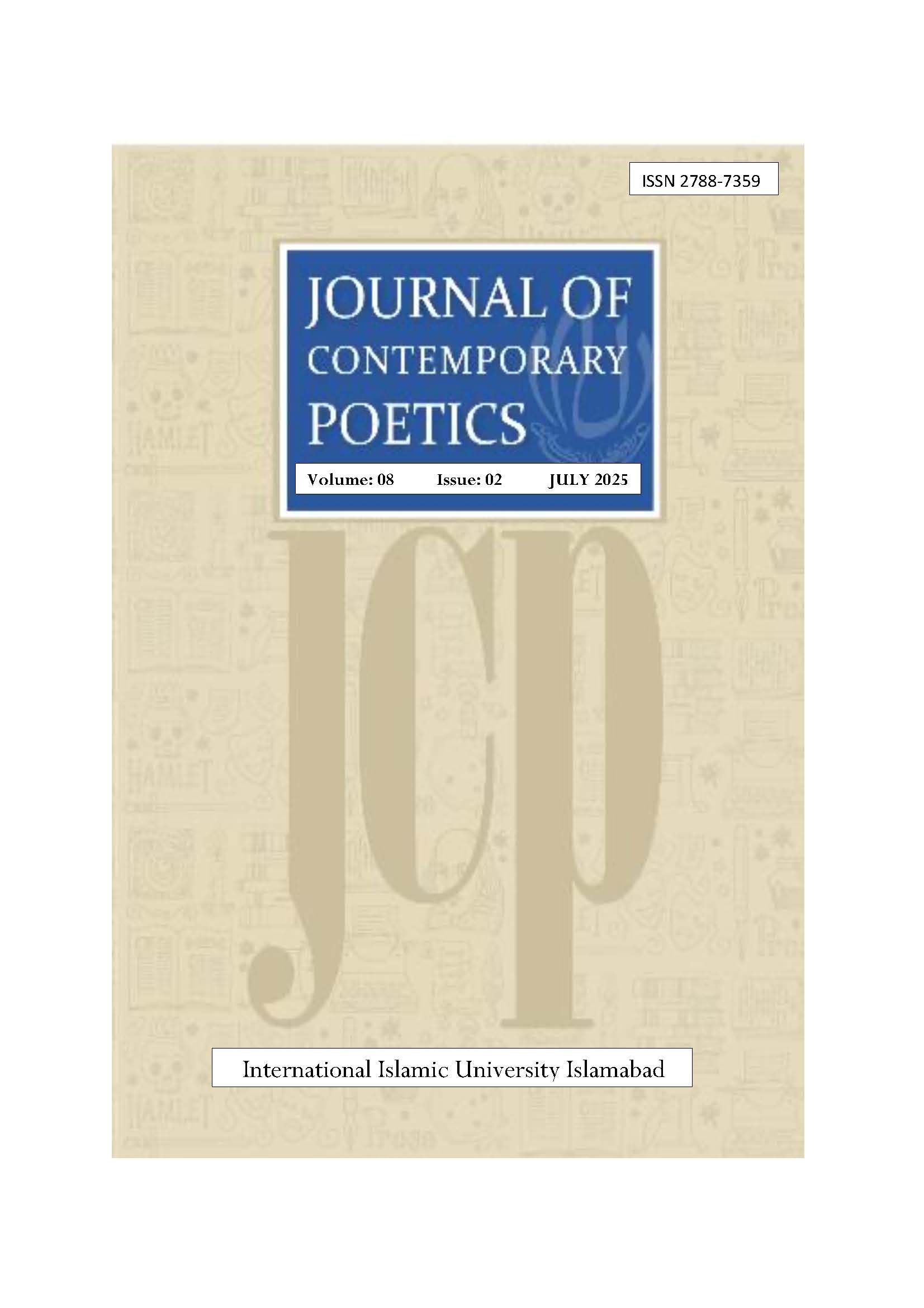
Lyotard’s Notion of Metanarratives in High Muck a Muck: Playing Chinese
DOI:
https://doi.org/10.54487/jcp.v8i2.7227Abstract
High Muck a Muck: Playing Chinese is a digital poem, but an interactive experience. Developed through an interdisciplinary effort of eleven Canadian artists, programmers, and community members, the project comprises an interactive website, eight videos, and a gallery installation. The digital text explores the theme of Chinese immigration to Canada’s West Coast, highlighting both historical and contemporary issues faced by diasporic communities in the host country. This research examines the work through the postmodernist framework of French theorist Jean-François Lyotard, particularly his claim regarding the demise of metanarratives or grand narratives. Postmodernism is marked by scepticism towards established beliefs and absolute truths. Lyotard challenges the validity of Western metanarratives, arguing that such grand narratives have lost their authority in the postmodern world. As High Muck a Muck: Playing Chinese engages deeply with diasporic issues, it implicitly rejects dominant narratives surrounding immigration to Western societies. Like other digital texts, it incorporates texts, images, videos, and sound, all of which will be analysed through Lyotard’s lens to support the argument for the death of metanarratives. The text confronts and critiques prevailing narratives of multiculturalism, racial harmony, materialism, and economic prosperity in Western, particularly Canadian, contexts.
Downloads
Published
Issue
Section
License
Journal of Contemporary Poetics by the Department of English, International Islamic University Islamabad and the articles published therein are licensed under a Creative Commons Attribution-Non-Commercial 4.0 International License. It is located on the domain of www.iiu.edu.pk . Permissions beyond the scope of this license may be available at Licensing and Copyright. This permits anyone to copy, redistribute, transmit and adapt the work provided the original work and source is appropriately cited as specified by the Creative Commons Attribution License. The journal allows readers to freely read, download, copy, distribute, print, search, or link to the full texts of its articles and to use them for any other lawful purpose. Once published the copyrights are retained with the Journal.
This work is licensed under Creative Commons — Attribution-NonCommercial 4.0 International — CC BY-NC 4.0

Attribution-NonCommercial
CC BY-NC